



The UK population spends on health and fitness clubs an estimated two billion pounds annually. It is fair to say that it is an enormous market, and one that is only ever expanding. The importance of leading a healthy lifestyle, eating well and taking plenty of exercise filters into every walk of life. It has become core to the marketing strategies for, well, pretty much everything!
But, could all this healthy living, eating well and taking plenty of exercise, actually be bad for your oral health! Dentists are spotting an emerging trend with people who are outwardly very healthy (sometimes professional athletes) needing to have treatment due to tooth decay.
These people take care of themselves physically and eat a well-balanced diet, without consuming any of the stereotypical high sugar foods that people would associate with dental decay. Dr Ian Need leman published an article titled ‘Body of Gods, Teeth of Yobs’ (link below) highlighting poor oral health of olympic level athletes.
I recently treated a Patient called Tess, a 25 year-old personal trainer. She attended as one of her lower teeth had chipped. On inspection, a piece of one of her back teeth had broken because of extensive decay below. You can see from the photos that decay is usually far more extensive than it may appear. After an inspection of her whole mouth, 7 other teeth had decay in them too. Tess was very surprised as she had never needed any dental work in the past, and had considered herself ‘healthy’. Fortunately for Tess, all her decay was fixable.
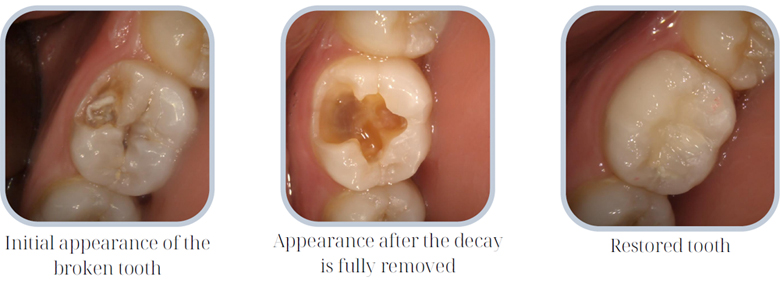
How is this happening then. Everyone knows sugar is bad for your teeth, so if you have a low sugar diet, how can you still get decay?
The reality is that sugar on its own doesn’t cause any damage to your teeth. Sugar, or more specifically carbohydrate is a fuel. Our bodies need it for our workouts, but it also fuels the millions of bacteria that live in our mouths. Sadly, the bacteria living in our mouths metabolise carbohydrate into acid, and this causes tooth decay.
Your saliva is wonderful at neutralizing the acid and returning our mouths to a state where tooth decay doesn’t occur. But it takes time, approximately 45-minutes. Thus, it is not how much carbohydrate or sugar you consume in total that is an issue. The issue is how often you consume it. Every new mouthful of anything containing carbohydrate will result in a 45-minute period of oral acidity.
This brings us back to our ‘healthy’ patients who are questioning why they are developing tooth decay. If you are highly active, then the chances are that you will be fuelling and hydrating yourself far more frequently. Which, unless you are only consuming pure water, is exposing your teeth to a far higher frequency of bacterial acid, which can lead to tooth decay.
The good news is that it is easy to reduce your risk to developing decay. The Department of Health published a comprehensive guide titled ‘Delivering better oral health: an evidence-based toolkit for prevention’. This guidance provides details of best practice advice and actions (along with the strength of the evidence behind the recommendation) for all age ranges on the prevention of oral disease. It comprehensively covers advice on dental decay, gum disease, oral cancer, tooth wear and oral hygiene. It also details the interventions dental professionals should be taking to support their patients along with additional measures which higher risk patients showing cause for concern should adopt. Professor Needleman’s studies found that most elite and professional athletes after dental examination would be considered as cause for concern for their caries risk.
Recommendations for preventing decay for all adults:
Professional interventions
Recommendations for adults giving concern because of dental decay risk:
Professional interventions
Reference: Needleman et al. Oral health and impact on performance of athletes participating in the London 2012
Olympic Games: a cross-sectional study. British Journal of Sports Medicine 2013; 47: 1054-1058